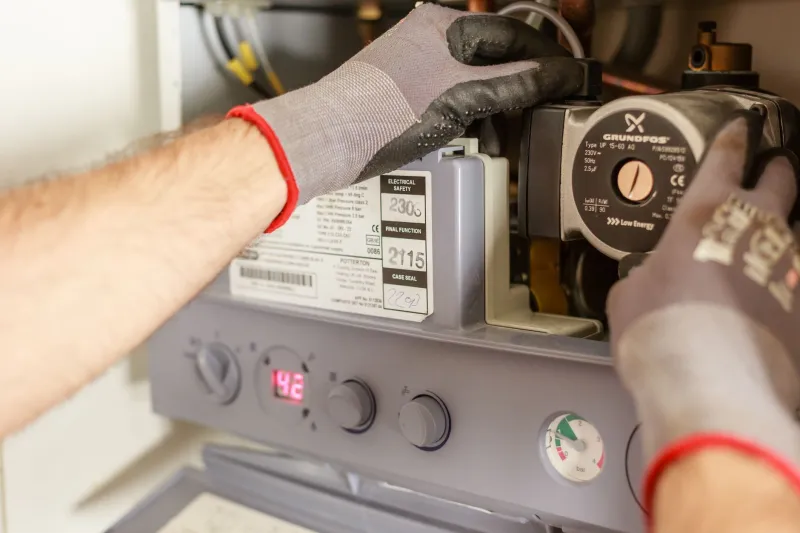
Before the Drill Comes Out: A Homeowner’s Guide to Siting a Glow-worm Properly
Photo: gailhampshire from Cradley, Malvern, U.K, CC BY 2.0, via Wikimedia Commons
A boiler replacement rarely starts with a deep discussion about geometry. It usually starts with someone pointing at a cupboard and saying, “It can go in there, can’t it?” The old boiler may have lived there for years, the space looks about right, and the cupboard door closes neatly. Job done. Except the location is not a side issue. It shapes how the Glow-worm performs, how it is serviced, how noisy it feels in the kitchen, and how much you pay when something needs attention in 2026.
The cupboard illusion
Kitchen cupboards are tempting because they are already there. They hide pipework, keep the boiler out of sight, and make a small utility room feel less cluttered. But a cupboard is a storage box with a door, not a plant room. Boilers need air, clearance, access, and a sensible route for the flue and condensate. They also need to be reachable by a Gas Safe registered engineer without half the kitchen being dismantled first.
This is why the best-looking installation can become the most expensive one to maintain. If the engineer has to remove shelves, slide out a washing machine, or kneel sideways to reach an isolation valve, that time gets billed. If the flue is awkward to inspect, the service may take longer. If the condensate pipe is tucked into a cold corner, winter becomes a worry. None of that shows up in the glossy finish.
Start with the flue, not the cupboard
The flue is often the first thing that rules a location in or out. A Glow-worm needs a flue route that satisfies the manufacturer’s instructions and the relevant Building Regulations, with the right clearances from windows, doors, vents, boundaries, and other buildings. Plume is part of the conversation too. A terminal that sends a cloud of vapour across a walkway, into a neighbouring window, or over a patio can be legal and still be annoying.
Before anyone cuts a hole, ask where the flue will run and where it will terminate. Is there a straight route, or will it need bends? Is the terminal position practical for the house as it is now, not just as it looks on a plan? A flue that exits into a narrow gap or under a low soffit may work on paper but create problems in real life. If the answer is vague, that is your cue to slow down.
Condensate is the quiet troublemaker
Modern boilers produce condensate, and it has to go somewhere. Gravity is ideal: a pipe with a steady fall to a suitable drain or soakaway. But boilers are often moved away from drains, and that can mean a condensate pump. Pumps are fine when specified properly, but they add a component that can fail, make a small noise, and need access.
Cold routes matter in the UK. A condensate pipe that runs through a garage, along an outside wall, or through a loft can freeze in a sharp cold snap. That does not mean the location is impossible, but it does mean the route needs thought, insulation, and sometimes a different plan. A neat copper pipe run is not much comfort if the heating locks out on a frosty January morning.
Service access is not a luxury
A boiler service should not feel like a puzzle box. The engineer needs to reach the boiler, remove covers, inspect the flue, check components, and use test equipment. Clearance in front of the appliance matters, and so does clearance around the sides where the manufacturer requires it. Boxing the boiler into a tight cupboard with fixed shelves may look smart, but removable panels and sensible isolation valves make a real difference.
Ask yourself a simple question: if someone needed to work on this boiler for an hour, could they do it without moving furniture or emptying a cupboard? If not, the location is already costing you something, even if the boiler is brand new.
Noise travels further than you think
A Glow-worm boiler is not usually a noisy appliance, but location changes how it sounds. A kitchen cupboard can amplify fan noise and vibration. A wall shared with a bedroom or living room can turn a gentle hum into a background irritation. A garage or utility room may be better acoustically, but only if the condensate and flue routes work.
Think about when the boiler will run hardest: early mornings, bath time, cold evenings. That is when any noise will be most noticeable. If the chosen spot is beside a headboard or under a favourite armchair, it may be worth reconsidering before the pipework goes in.
The hidden cost of a very tidy install
A compact installation can be excellent. But tight spaces often need extra parts: flue bends, condensate pumps, longer pipe runs, additional insulation, or making good after boxing in. Those costs are not necessarily bad value if they are planned. They become a problem when they are discovered halfway through the job.
Get the location agreed in writing before work starts. Ask where the flue terminates, how the condensate drains, what access will remain, and whether any cupboard shelves or appliances will need to move. A good installer will welcome those questions. A vague answer about “making it fit” is not a specification.
A quick pre-drill checklist
Before the first hole appears, confirm the flue route and terminal position, the condensate route and frost risk, the service clearances, and the noise implications. Check that the boiler can be isolated and accessed without emptying a room. Look at the space as a working area, not just a storage gap.
A Glow-worm boiler deserves a sensible home. The cupboard may be where the old one lived, but that does not make it the right place for the new one. In 2026, with heating costs still on everyone’s mind, the smartest installation is the one that is easy to run, easy to service, and unlikely to surprise you later.